Four chords will get you through a startling number of the songs you already know. In the key of C they are C major, G major, A minor, and F major, played in that order and looped. That single progression sits under pop ballads, folk songs, worship music, and film themes, and none of it requires reading notation. What follows is that progression and three more, why each one sounds the way it does, and how to try them tonight.
The four chords behind half the radio
Play C, then G, then A minor, then F, four beats each, and go back to C. Even played badly it sounds like a song.
The short version of why is on our chord player page: G pulls hard towards C, and the loop swerves to A minor instead of giving in. Dominic Pedler, in The Songwriting Secrets of The Beatles, calls that swerve the interrupted cadence. The tension gets deferred rather than paid off, so the loop wants to keep turning, and the F at the end brings you home gently instead of forcefully. That is why the whole thing feels warm rather than triumphant.
The longer version is about what your hand is doing. Write out the notes:
- C major is C, E, G
- G major is G, B, D
- A minor is A, C, E
- F major is F, A, C
Every neighbour in that loop shares at least one note with the chord before it. C and G share G. A minor keeps two of C major's three notes, C and E, and F keeps two of A minor's, A and C. So if you move each finger to the nearest note of the next chord, most of your fingers stay where they are and one or two move a single step. The ear hears that as one line of music moving, not four separate blocks being stacked. Beginners who jump the whole hand to a new root position every bar lose exactly that smoothness, and it is the main reason a correct progression can still sound clunky.
The same wheel, started somewhere sadder
Take those four chords and begin on A minor instead: A minor, F, C, G. Identical chords, completely different mood. Starting on the minor chord makes the ear hear A as home for a while, and the G at the end now leaves the phrase hanging open instead of closing it.
This is the cheapest good trick in songwriting. If a verse feels too bright, start the loop one chord later.
Borrowing a chord that does not belong
Now try C, then B flat, then F, then back to C. B flat is not in the key of C. It comes from the darker, minor-flavoured version of the key, and borrowing it is the move Pedler ties to the rise of rock: import one chord from outside and a polite progression grows teeth. That specific shape, B flat to F to C, is common enough to have a name, the double plagal, because it is two gentle "amen" steps in a row, and once you hear it you will hear it all over rock and folk rock.
Play the four-chord loop and this one back to back. Nothing changed except one chord, and the genre moved.
When the bass walks down
The fourth pattern is less a chord loop than a bass line with chords hung on it. Keep your right hand on a C major chord and walk the left hand down one step at a time: C, then B, then A, then G. Each new bass note quietly turns the same right hand into a different chord, and the downward motion gives the passage a feeling of gravity. Pedler files the chromatic versions of this under line cliches.
Pachelbel's Canon runs on a cousin of it. Its bass does not walk straight down; in C it goes C, G, A, E, F, C, F, G, dropping a fourth and climbing a step, so the whole line keeps sinking for three hundred years of weddings. The Canon is in Piano Aura's Piano Game, so you can watch that pattern move under your hands before you try it yourself.
How to try these without learning theory first
You do not need to be able to spell a chord to play a progression. Two ways in:
If you are at a computer, our free chord player builds any chord in the browser. Pick C, hear it, pick A minor, hear it, and step through the loop at your own pace. Nothing to install.
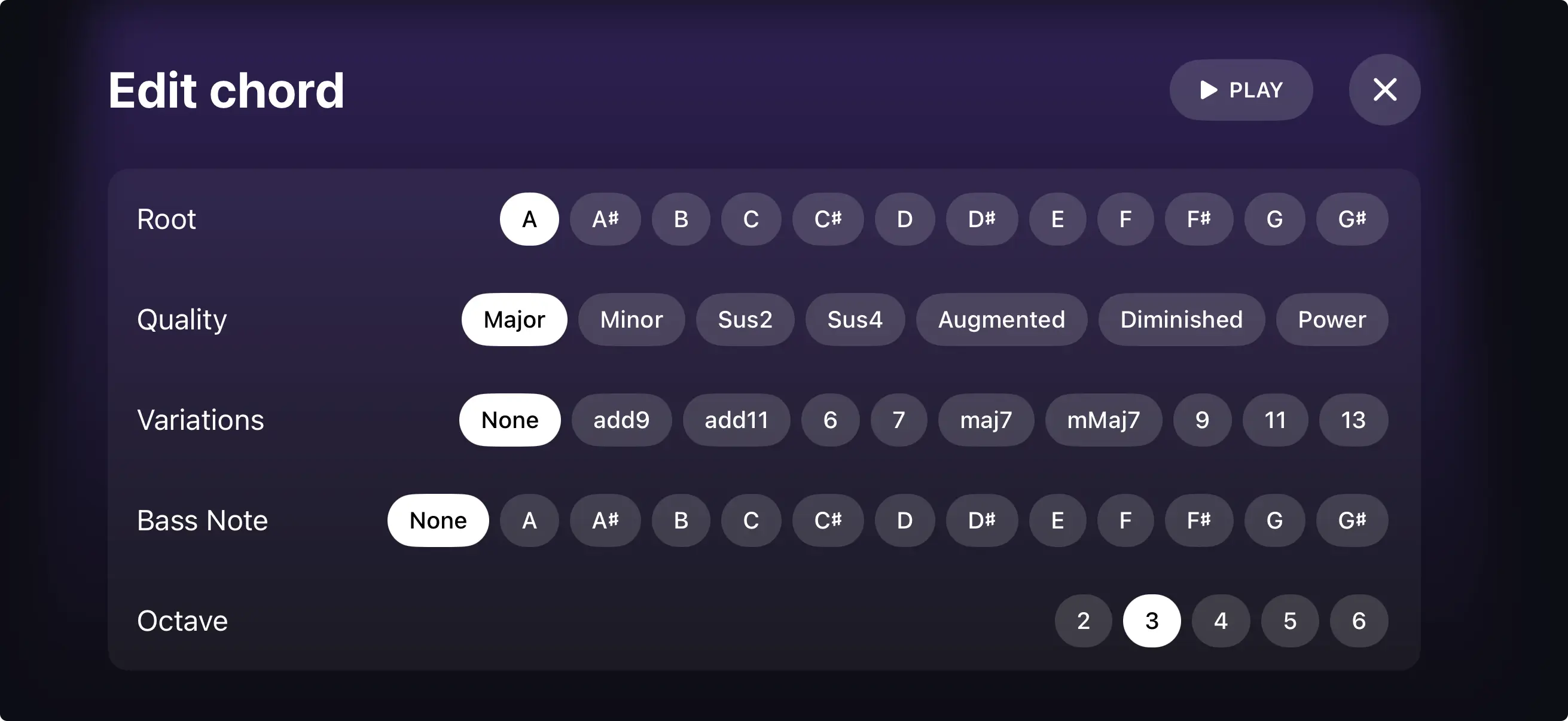
On an iPhone or iPad, Piano Aura's Chord Builder does the same job. Choose a root and a quality, tap PLAY to audition it, then find the same three notes on the Freestyle keyboard and play them yourself. When a progression starts to feel automatic, record it in Create Music and put a melody on top. If you want the full walkthrough on building the chords themselves, we covered that in how to play major and minor chords.
Questions people ask
What is the easiest chord progression on piano? C, G, A minor, F in the key of C, because all four are white-key shapes, neighbouring chords share notes, and the sequence is used in a huge number of songs.
Why do the same four chords work in so many songs? Because the melody and rhythm on top do the distinguishing. A progression is a frame, not a fingerprint. Pedler makes the point that pop songwriters reuse harmonic devices constantly and that what makes a song its own is the tune written over them.
How do I make chord changes sound smooth? Move each finger to the closest note of the next chord instead of jumping the whole hand to a new position. In C, G, A minor, F, at least one note carries over between each pair of neighbours, so most fingers barely move.
Can I play these progressions in another key? Yes. The pattern is about the relationships between the chords, not the letters. In G major the same loop is G, D, E minor, C. Build the four chords in the chord player and the pattern sounds identical, just higher or lower.
Do I need both hands? No. Play the chords with one hand first. House of the Rising Sun and Greensleeves, both in the Piano Game catalog, are worth listening to while you practise, since both lean on repeating chord patterns you can pick out by ear.
How long before this sounds like music? Most people get one loop sounding steady inside a week of short daily sessions. Steady beats fast.
Piano Aura is free on the App Store if you want the keyboard, the chord builder, and the songs in one place.