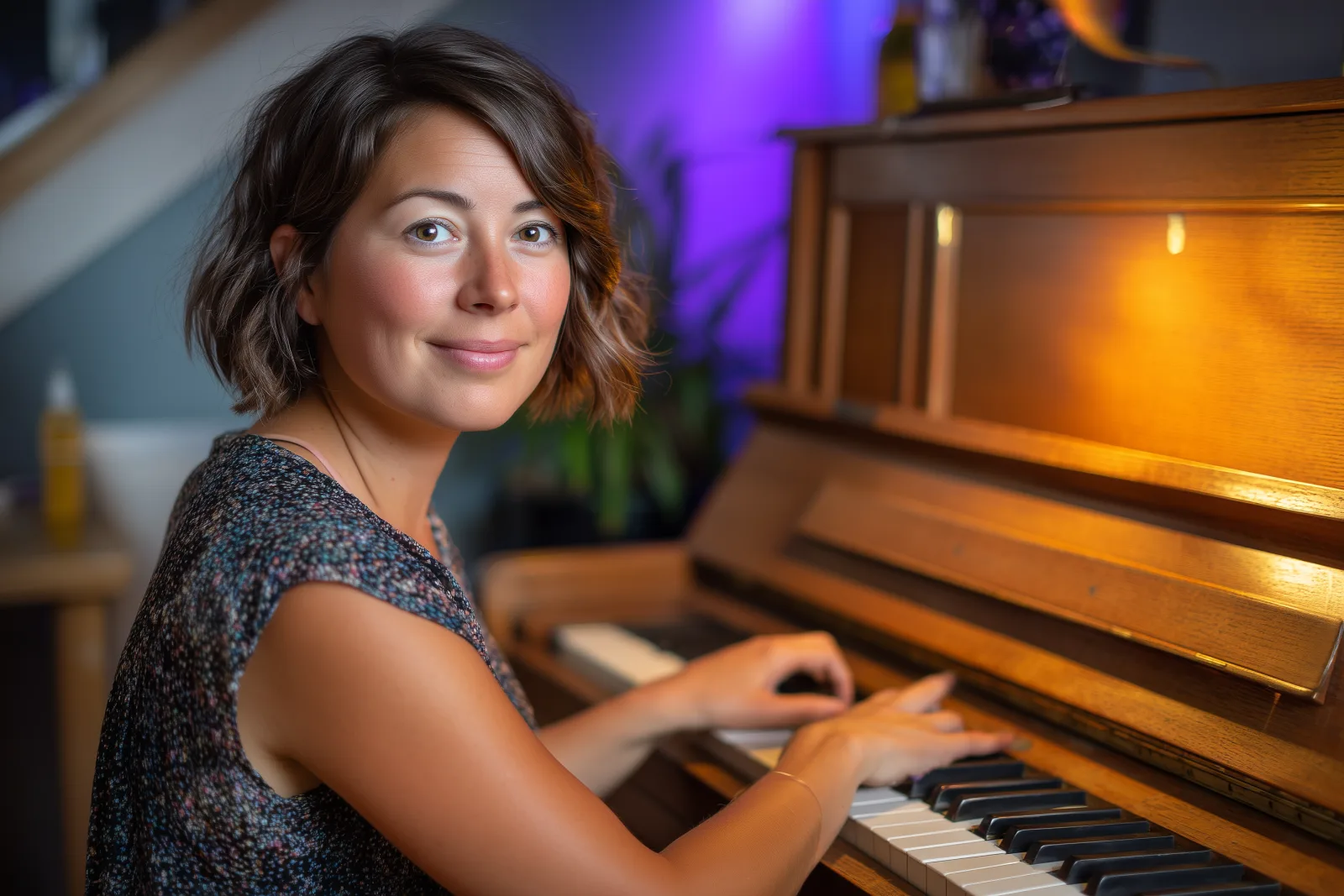
A complete beginner can play a short one-hand tune within a few days. Playing simple songs steadily, without staring at every note prompt, usually takes a few months. Feeling fluent across both hands takes years. Those ranges are broad because "learn piano" can mean anything from playing Happy Birthday at a party to reading a Chopin score at sight.
The useful question is not when you will finish. It is what you can reasonably expect at each stage.
What can you learn in the first week?
In the first few sessions, you can learn the keyboard layout and play a recognisable melody with one hand. That first tune may be slow and uneven. It still counts.
A falling-note mode can shorten the route to that first result because you do not have to decode notation before making music. In Piano Aura, Piano Game shows when to tap each note and lets you reduce the speed to 0.75x or 0.5x. That helps with timing, but it does not mean you have memorised the song yet. Try it once without the prompts to see what stayed with you.
What changes after one to three months?
With fifteen to twenty minutes of practice on most days, many beginners can play several simple melodies, move between a few basic chords, keep a steadier beat, and use both hands for easy patterns. The pauses between notes become shorter. Mistakes stop sending you back to the beginning every time.
This stage feels slower because the wins are less dramatic. Coordination improves through repeated sleep-and-return cycles, so five short sessions beat cramming the same time into Sunday afternoon.
If notation is blocking the habit, you do not have to start there. Playing piano without sheet music is a valid route, especially if your immediate goal is songs, chords, or playing by ear.
When will you sound good?
For a beginner playing straightforward songs, three to six months is a fair point to expect something that sounds settled to another person. You may still play slowly, but the pulse holds, the melody is clear, and you can recover from a wrong note.
That estimate assumes regular practice and a sensible piece. A song just beyond your current reach helps. A piece that demands large jumps, fast scales, and independent rhythms in both hands can make six months look like no progress at all.
How long does real fluency take?
A few years is the honest answer. Fluency means that common chord shapes feel familiar, both hands can do different jobs, and learning a new song no longer feels like starting the instrument again.
Sight-reading, improvisation, accompaniment, and performance are separate skills. Progress in one does not automatically produce the others. Decide which ability you want and spend time on it.
Does an app make learning faster?
An app can make starting easier and repetition more convenient. It can give you a keyboard when no piano is nearby, provide a steady timing target, slow a song down, and make a short session easy to begin. That matters because practice you start is more useful than an ideal routine you avoid.
It cannot watch your posture, choose efficient fingering, or hear that every note is being struck too hard. A glass screen also cannot teach key weight or dynamics. If your goal includes acoustic piano technique, add time on real keys and get occasional feedback from a teacher.
For days when a piano is unavailable, this ten-minute practice routine keeps note layout, rhythm, and ear work moving.
FAQ
How many hours a day should a beginner practise? Fifteen to thirty focused minutes is enough to progress. Stop before tired hands turn repetition sloppy. Two short sessions can work better than one long one.
Can I learn piano in six months? You can learn to play simple songs, basic chords, and beginner two-hand patterns in six months. You will not finish learning the instrument, and you do not need to.
Is thirty too old to start piano? No. Nor are forty, sixty, or eighty. Adults often have less free time than children, but they choose their own music and understand how they learn. A no-pressure adult beginner plan covers the practical side.
Why does my progress feel inconsistent? Because coordination develops unevenly. A skill can feel worse while your brain is replacing a clumsy movement with a better one. Judge progress by a recording made a month ago, not by yesterday.
Pick one small milestone for the next month: one tune from memory, three clean chord changes, or ten minutes of daily practice. Piano Aura is free on the App Store if an iPhone or iPad would make that first session easier to start.