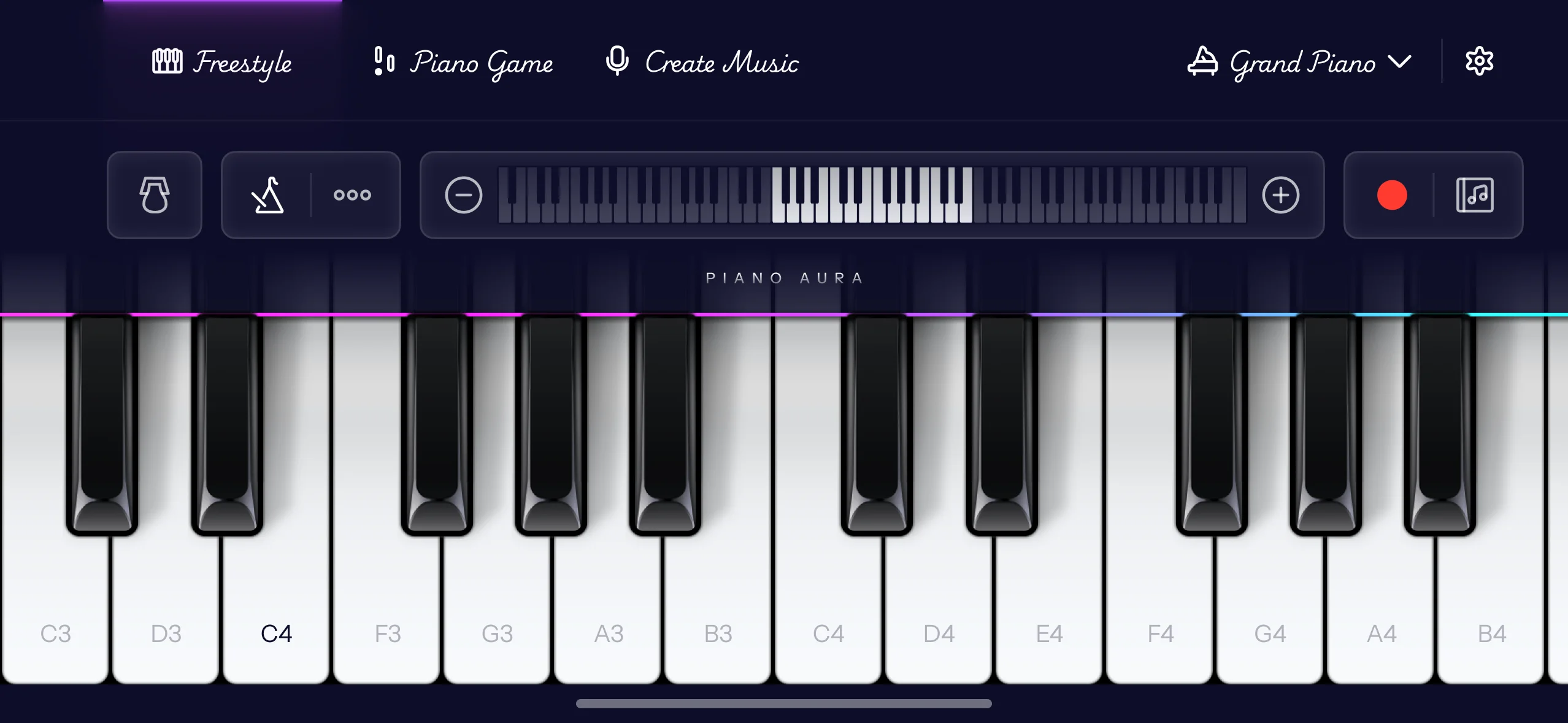
A freestyle piano keyboard is a full keyboard with nothing layered on top of it: no falling notes, no song to keep up with, no score telling you that you were late. You press keys, you hear notes. That is the whole feature, and it is the one people skip.
The emptiness is the point. Following a song teaches your hands a path someone else laid down. A blank keyboard is where you start laying down your own.
Why "just messing around" is actually composing
Every song you've ever liked started as someone messing around. They found a couple of notes that sounded good together, played them again, and built out from there. There's no secret first step that involves theory. The theory is a way of explaining what already sounded good, after the fact.
So the fastest way to start writing music is to lower the stakes until there are none. Sit at a blank keyboard and play badly on purpose for five minutes. Somewhere in there you'll hit two or three notes that make you stop. That's the seed.
A five-minute way in
If you want something concrete to try, and you are at a computer right now, you can do all of it on our free online piano before you install anything. The letter keys play the notes.
Play three or four notes near the middle of the keyboard, slowly, in a little pattern. Repeat it until your hand remembers it. Keep it simple on purpose: two or three note lengths, small steps between the notes.
Now hold one low note with your left hand underneath it. That single note is doing the job of a whole chord, and suddenly the pattern sounds like a piece of something.
Change one note in your right-hand pattern and listen to what it does. That's it. That's writing. You're making choices about what sounds right, which is the entire job.
The trick is to record while you do this, because good accidents vanish in seconds. Play it back and you'll keep going. Don't, and you'll have forgotten the best bit by dinner.
How three notes turn into an actual phrase
The thing you just played has a name. Arnold Schoenberg calls it the motive, and in Fundamentals of Musical Composition he treats it as the germ of the piece: the small figure everything later grows out of. His advice to keep it simple is not a beginner concession. He points out that Beethoven's Fifth is built mostly on a repeated note, and that a basic motive with too many different rhythms and intervals crammed into it is harder to develop, not easier.
What you do next is the part most people get wrong in both directions. Play the figure over and over unchanged and it turns into wallpaper within about twenty seconds. Change everything about it and the listener stops hearing the same piece at all. Schoenberg's answer, which he calls developing variation, sits between those: repeat the figure, but change one less-important thing each time and hold on to the parts that carry its identity.
In practice, for a beginner sitting at a blank keyboard, that means:
Keep the rhythm and move the notes. Play your figure exactly as before but start it one key higher. Same shape, new position, still obviously the same idea.
Keep the notes and change one length. Hold the second note twice as long. The figure suddenly leans somewhere.
Change the note underneath. Leave the right hand alone and move your left-hand bass note down a couple of keys. The same three notes now mean something different, because the harmony under them changed.
Rhythm is the anchor. Schoenberg's rule is that preserving rhythmic features is the most effective way to keep a piece coherent, so when a variation stops sounding related to what came before, the rhythm is usually the thing you dropped. Put it back and the connection returns.
Do that four or five times and you have not just messed around. You have a phrase, built the way phrases are actually built.